


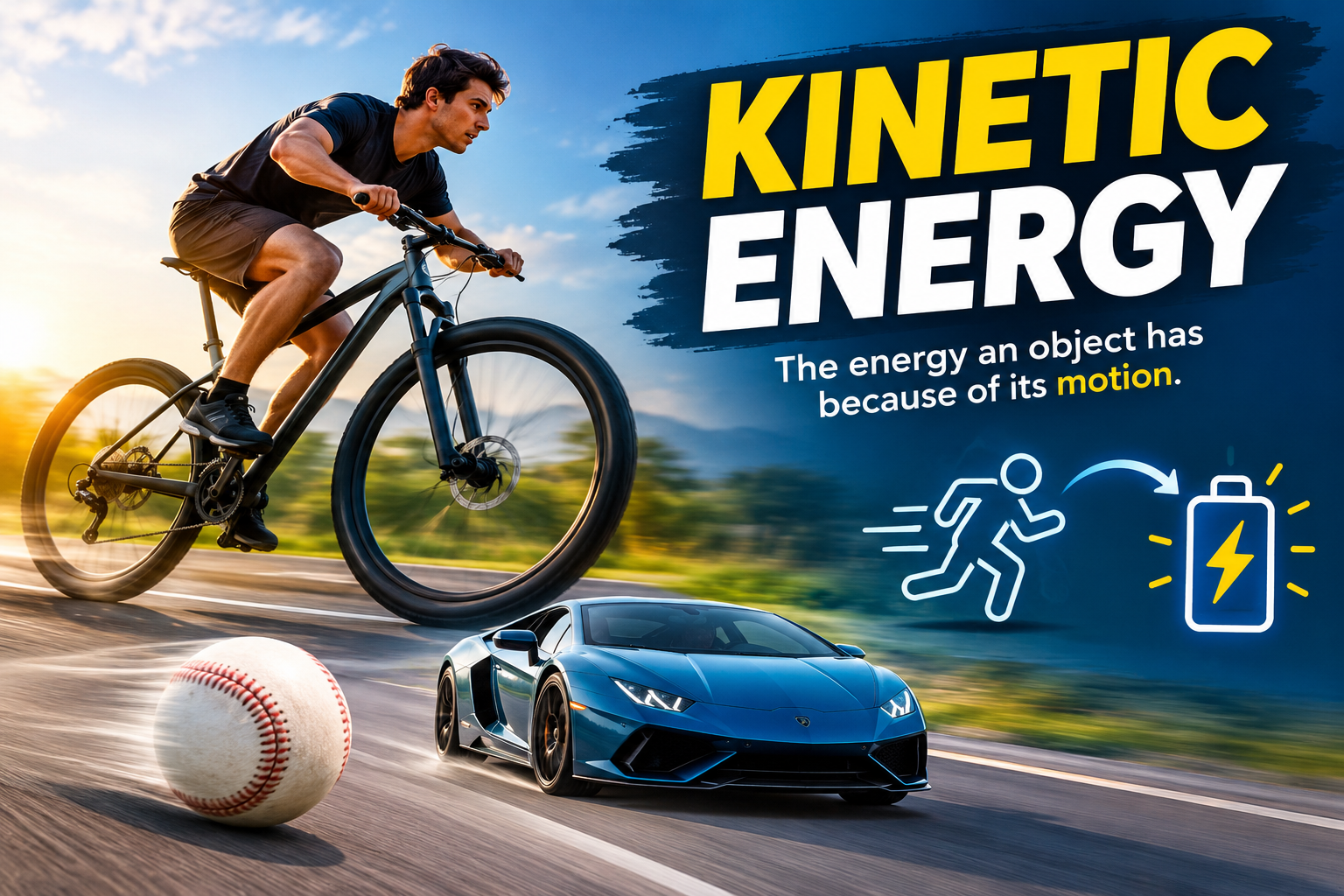
What Exactly Is Kinetic Energy
Kinetic energy represents the energy an object possesses due to its motion. Any object that moves, whether a rolling ball, a flying airplane, or a flowing river, carries this form of energy. The faster the object travels and the greater its mass, the more energy it holds. This concept forms a core part of classical physics and helps explain countless natural and engineered processes around us.
Scientists define kinetic energy as the work needed to accelerate a body of a given mass from rest to its current velocity. Once in motion, the object maintains that energy until external forces slow it down or stop it. Understanding this principle allows engineers, athletes, and everyday people to predict outcomes in collisions, design safer vehicles, and optimize performance in sports.
The Fundamental Formula Behind Kinetic Energy
The mathematical expression for kinetic energy is simple yet powerful. It equals one half the product of an object’s mass and the square of its velocity. In symbols this appears as KE equals one half m v squared. Mass is measured in kilograms and velocity in meters per second, producing a result in joules.
Because velocity is squared, small increases in speed produce large jumps in energy. Doubling the speed multiplies the kinetic energy by four. This relationship explains why high-speed impacts release far more destructive force than low-speed ones. Engineers rely on this formula when calculating braking distances, crash test results, and the energy requirements of moving machinery.
Types of Kinetic Energy Found in Nature and Technology
Translational Kinetic Energy
Translational kinetic energy describes the energy of an object moving in a straight line or along a curved path without rotating. A car driving down a highway or a bullet fired from a gun both carry translational kinetic energy. The entire body moves as a single unit through space.
Rotational Kinetic Energy
Rotational kinetic energy appears when an object spins around an axis. A spinning flywheel, a rotating planet, or a gyroscope stores energy in its angular motion. The formula adjusts to account for moment of inertia and angular velocity rather than linear mass and speed. Machines such as turbines and electric motors harness this form of energy efficiently.
Vibrational Kinetic Energy
Vibrational kinetic energy occurs when particles or objects oscillate back and forth. Molecules in a heated gas, strings on a musical instrument, and the oscillating components of engines all exhibit this type. Although less visible than translational motion, vibrational energy plays a major role in heat transfer and sound production.
Everyday Examples That Demonstrate Kinetic Energy
A soccer ball kicked across a field instantly gains kinetic energy from the player’s foot. The greater the force applied, the higher the speed and the farther the ball travels. Similarly, a roller coaster at the bottom of a hill converts the potential energy gained at the top into rapid motion, delivering an intense rush of kinetic energy to the riders.
In traffic, every moving vehicle carries kinetic energy proportional to its mass and speed. Modern safety systems such as crumple zones and airbags are designed to absorb and redirect that energy during collisions, protecting passengers. Even a simple falling raindrop possesses kinetic energy that can be felt as it strikes the ground or a surface.
Athletes constantly manage kinetic energy. A sprinter’s body accelerates, storing energy that must later be controlled during deceleration. Basketball players convert muscular effort into the kinetic energy of a jumping leap or a fast pass. Understanding these transfers improves training techniques and reduces injury risk.
How Kinetic Energy Relates to Potential Energy
Kinetic energy rarely exists in isolation. It frequently transforms from or into potential energy. A rock held at the edge of a cliff stores gravitational potential energy. Once released, that stored energy converts into kinetic energy as the rock falls and gains speed. At the moment of impact the kinetic energy dissipates as heat, sound, and deformation.
Pendulums offer a clear demonstration of continuous conversion. At the highest points of its swing the pendulum holds maximum potential energy and nearly zero kinetic energy. At the lowest point the situation reverses: potential energy reaches its minimum while kinetic energy peaks. This back-and-forth exchange continues until friction gradually removes energy from the system.
Practical Applications Across Industries
Transportation systems depend heavily on accurate calculations of kinetic energy. Automotive designers use the formula to determine stopping distances and the strength of structural materials. Aerospace engineers calculate the enormous kinetic energy of aircraft and spacecraft to ensure safe landings and re-entries.
Renewable energy technologies also rely on this principle. Wind turbines capture the kinetic energy of moving air and convert it into electrical power. Hydroelectric plants harness the kinetic energy of flowing water. Even some experimental wave-energy converters extract energy from the motion of ocean surfaces.
In manufacturing, high-speed machining tools and industrial robots operate with carefully controlled kinetic energy levels. Too much energy risks damage to equipment or products; too little reduces efficiency. Precision control systems continuously monitor and adjust motion to maintain optimal energy balances.
Safety Considerations Linked to Kinetic Energy
Because kinetic energy increases with the square of velocity, relatively modest speed increases can create disproportionately dangerous situations. Traffic safety campaigns emphasize this relationship when advocating lower speed limits in residential areas. A vehicle traveling only slightly faster carries significantly more energy that must be absorbed in any collision.
Sports equipment manufacturers design helmets, pads, and barriers specifically to dissipate kinetic energy. The materials compress or deform in controlled ways, lengthening the time over which energy is transferred and thereby reducing peak forces on the human body. Similar principles guide the construction of playground surfaces and vehicle restraints.
Measuring and Calculating Kinetic Energy in Real Situations
Accurate measurement begins with determining mass and velocity. Laboratory settings use precise scales and motion sensors or high-speed cameras. In field conditions, radar guns, GPS devices, and accelerometers provide velocity data. Once both values are known, the standard formula yields the kinetic energy instantly.
For rotating objects the calculation grows more involved. Engineers must first determine the moment of inertia, which depends on the distribution of mass relative to the axis of rotation. Computer-aided design software often performs these calculations automatically for complex shapes.
Common Misconceptions About Kinetic Energy
Some people believe that heavier objects always possess more kinetic energy regardless of speed. In reality, a light object moving very fast can easily exceed the kinetic energy of a heavy object moving slowly. The squared velocity term dominates the relationship.
Another misconception treats kinetic energy as a permanent property of an object. Energy is never destroyed, yet it readily transforms. When a moving object stops, its kinetic energy has transferred into other forms such as heat, sound, or deformation rather than vanishing.
The Broader Importance of Understanding Kinetic Energy
Mastery of kinetic energy concepts strengthens scientific literacy and practical problem-solving skills. Students who grasp the relationship between mass, velocity, and energy gain deeper insight into mechanics, thermodynamics, and even astronomy. Professionals in engineering, sports science, and safety design apply these ideas daily to create better products and safer environments.
From the motion of subatomic particles to the orbits of planets, kinetic energy remains a universal language of physics. By learning its principles, individuals gain a clearer view of how the physical world operates and how human technology can work in harmony with natural laws.
Conclusion
Kinetic energy stands as one of the most practical and widely applicable ideas in physics. It quantifies the energy of motion and reveals how mass and speed interact to produce real-world effects. From simple toys to complex machines, every moving object demonstrates this principle. Understanding the formula, the various types, and the continuous exchange with potential energy equips people to design safer systems, improve athletic performance, and harness natural forces more efficiently. Whether observed in a falling leaf or a high-speed train, kinetic energy remains a constant reminder that motion itself carries measurable power. Continued study and application of these concepts will keep advancing technology and deepening our appreciation of the physical universe.
