


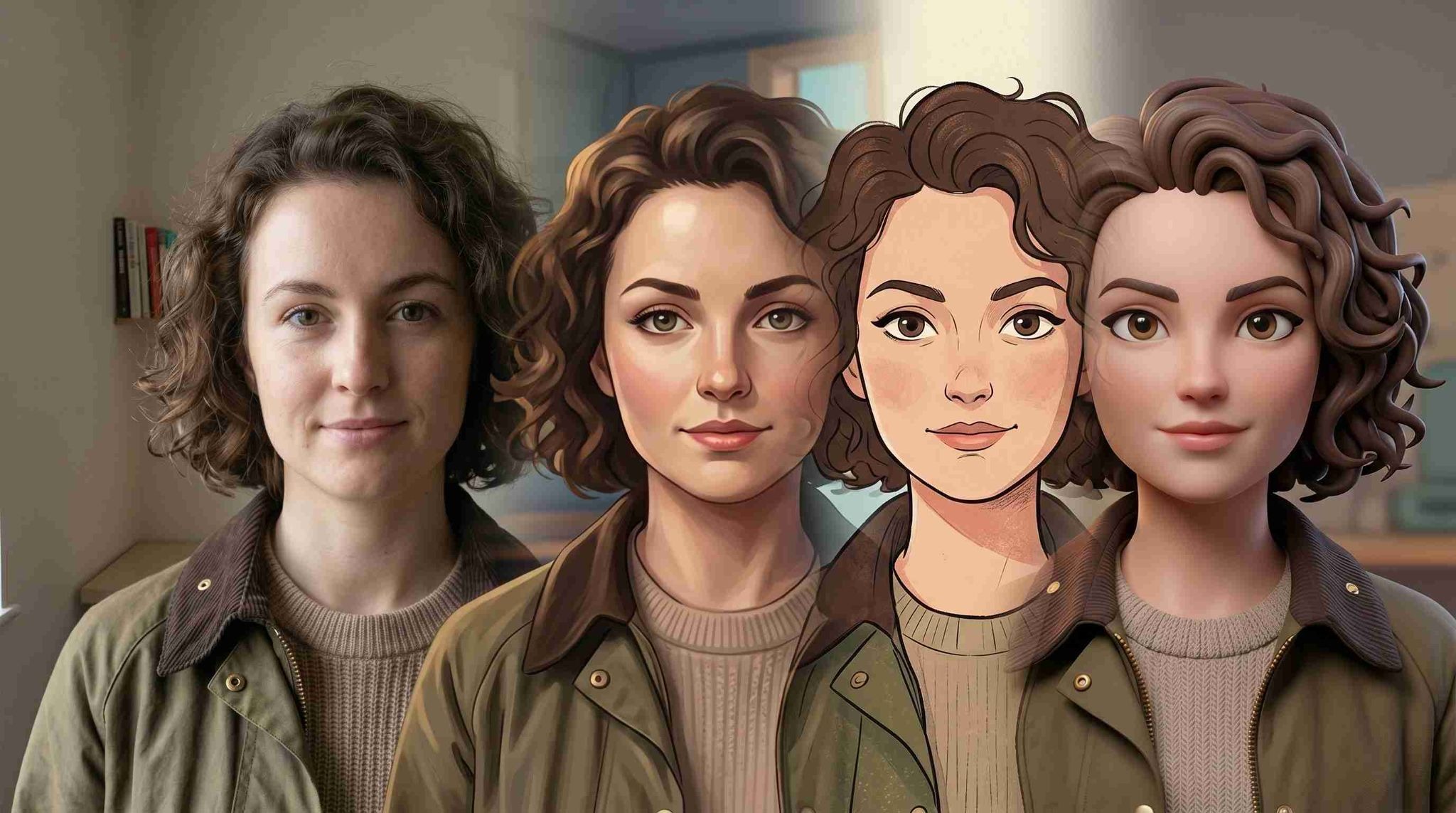
Animation has always depended on reference.
Not inspiration. Not imagination.
Reference.
Even the most stylized characters are grounded in real-world observation. Movements, expressions, timing, and emotional cues all come from something that exists or existed.
For decades, this meant one thing.
More footage. More sketches. More capture sessions.
Now that equation is shifting.
And face swap is quietly becoming one of the most important tools in that transition.
Reference Work Was Always the Bottleneck
Animation pipelines are not limited by ideas.
They are limited by input.
Before a character moves convincingly, animators need reference material that reflects:
- Facial expressions
- Micro-movements
- Emotional transitions
- Performance timing
Traditionally, this meant recording actors, running motion capture sessions, or building reference libraries manually.
All of this takes time.
And more importantly, it limits flexibility.
The Shift From Capturing to Transforming
What’s changing is not how reference is used.
It’s how it is sourced.
Instead of capturing new footage, animators are now transforming existing footage.
A performance no longer needs to match the character.
It just needs to exist.
This is where face swap becomes relevant inside animation workflows.
Within Higgsfield, identity can be layered onto existing motion, allowing animators to separate performance from character design.
That separation is the key shift.
Identity and Performance Are No Longer Linked
In traditional workflows, identity and performance were tied together.
If you wanted a character to express something specific, you needed an actor who could perform it.
Now, those two elements can be handled independently.
A single performance can be reused across multiple identities.
That means:
- One actor → multiple characters
- One motion → multiple styles
- One reference → multiple outputs
Higgsfield enables this by keeping facial mapping consistent while adapting identity.
This reduces the need for repeated capture sessions.
From Static Reference to Dynamic Systems
Reference is no longer static.
It is becoming dynamic.
Instead of collecting reference material, animators are building systems that generate it.
Face swap plays a central role here.
A single input can now produce multiple variations:
Different characters
Different emotional tones
Different visual styles
This transforms reference sourcing into an active process rather than a passive one.
Faster Iteration Changes Creative Decisions
Animation thrives on iteration.
But iteration has always been expensive.
Each variation required new reference, new adjustments, or manual refinement.
With face swap, iteration becomes faster.
Animators can test:
- Multiple character expressions
- Alternate identity mappings
- Different emotional interpretations
Without restarting the pipeline.
Higgsfield supports this by maintaining consistency across outputs, which allows experimentation without breaking continuity.
One-Image Character Workflows Are Emerging
One of the most significant changes is how little input is now required.
Modern systems can work with minimal data.
In some cases, a single image is enough to establish identity.
From there, motion and expression can be applied.
This drastically reduces the need for:
- Multi-angle reference shoots
- Expression sheets
- Extensive modeling stages
Face swap becomes the bridge between static identity and dynamic performance.
Reducing Dependency on High-End Capture Systems
Traditional animation pipelines often rely on expensive systems.
Motion capture setups can cost thousands or even millions.
They require:
- Dedicated spaces
- Specialized hardware
- Technical expertise
Face swap reduces this dependency.
Existing footage can be repurposed.
Basic recordings can be enhanced.
High-end results can be achieved without high-end infrastructure.
Higgsfield makes this accessible, allowing smaller teams to operate with greater flexibility.
Empowering Independent Creators
This shift is especially important for smaller studios and independent animators.
Access to high-quality reference material has always been a barrier.
Now, that barrier is lower.
Creators can:
- Use existing videos as reference
- Apply custom identities
- Generate performance variations quickly
Face swap turns limited resources into scalable outputs.
Higgsfield supports this by simplifying complex processes into usable workflows.
Expanding Creative Possibilities
When reference becomes flexible, creativity expands.
Animators can explore ideas that were previously impractical.
For example:
- Testing multiple character designs on the same performance
- Creating alternate casting scenarios instantly
- Blending different artistic styles with the same motion
Face swap allows these experiments without additional production effort.
This encourages more exploration and less restriction.
The Role of Image-to-Image Translation in This Shift
A deeper technical layer explains why this transformation is possible.
Modern AI systems don’t just edit images. They learn mappings between visual representations.
Techniques introduced in research like image-to-image translation using conditional adversarial networks show how a system can convert one visual format into another while preserving structure.
This means:
- A sketch can become a photo
- Edges can become objects
- Layouts can become scenes
Face swap operates on a similar principle.
It learns how identity should behave within a scene rather than simply overlaying pixels.
That’s why outputs feel coherent.
Not pasted. Not artificial.
Structured.
From Reference to Output: The Line Is Blurring
One of the most interesting shifts is this:
Reference is no longer just reference.
In many cases, it is becoming part of the final output.
When quality reaches a certain level, the distinction between “guide” and “final” starts to disappear.
Animators can take AI-generated outputs and use them directly, reducing the gap between concept and completion.
Higgsfield supports this by producing outputs that are consistent enough to be usable beyond just reference stages.
Integration With Broader AI Workflows
Face swap is not a standalone capability.
It fits into a larger ecosystem that includes:
- Motion tracking
- Style transfer
- Generative image systems
Together, these tools create a complete pipeline.
Creators can move from idea to output without switching between disconnected processes.
Higgsfield plays a central role by acting as the identity layer within this system.
What This Means for the Future of Animation
Animation is becoming more adaptive.
More flexible.
More accessible.
The ability to generate and transform reference material quickly will define how efficiently teams can create.
Face swap is central to that shift.
It allows animators to think beyond limitations and focus on storytelling.
Conclusion
Animation has always depended on reference, but the way that reference is created and used is changing rapidly. Instead of relying on costly shoots and manual observation, animators can now transform existing material into flexible, high-quality reference systems.
Face swap plays a key role in this transformation by separating identity from performance, allowing creators to reuse motion, experiment with different characters, and iterate faster than ever before. This shift reduces production barriers while expanding creative possibilities.
With platforms like Higgsfield, these capabilities become accessible to a wider range of creators. As AI continues to evolve, reference will no longer be something that is collected. It will be something that is generated, adapted, and scaled as part of the creative process itself.
