


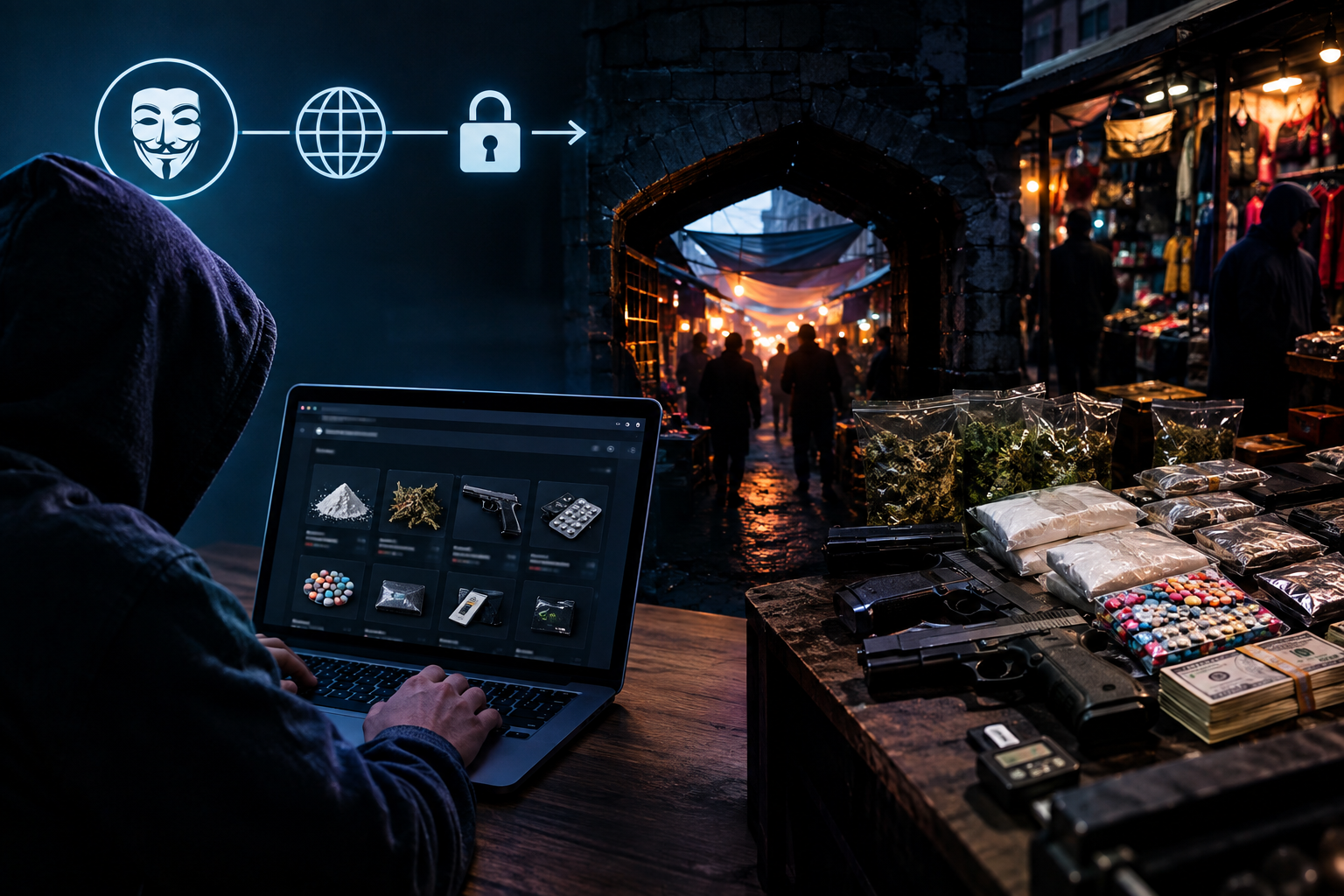
The term “black market” often appears in discussions about illegal trade, underground economies, counterfeit products, and restricted goods. It generally refers to transactions that take place outside the legal and regulated marketplace. Because these activities are intentionally hidden from authorities, black markets can involve significant legal, financial, and personal risks.
People may become interested in black markets for many different reasons. Some are curious about how underground economies operate, while others may encounter references to them online or through news reports. However, understanding the black market is very different from participating in it. Entering an unregulated marketplace can expose a person to fraud, identity theft, dangerous products, criminal investigations, and financial losses.
This guide explains the concept in detail, including how underground markets generally function, why they exist, the risks associated with them, and safer legal alternatives for obtaining products or services.
What Is the Black Market?
A black market is an economic system in which goods, services, or financial transactions are exchanged outside the legal framework established by governments and regulatory authorities.
Unlike ordinary businesses, participants in these markets may deliberately avoid licensing requirements, taxation, consumer protection laws, product standards, or other regulations.
Black-market activity can involve many different categories, including:
- Counterfeit products
- Stolen goods
- Smuggled merchandise
- Fraudulent documents
- Restricted products
- Illegal financial transactions
- Unlicensed services
- Certain prohibited substances
The exact activities considered illegal vary between countries and jurisdictions. Something that is legal in one location may be restricted or prohibited somewhere else.
How to access the black market
Why Do Black Markets Exist?
Black markets generally develop when there is demand for something that cannot easily be obtained through legitimate channels or when participants attempt to avoid legal restrictions.
Several factors can contribute to underground economic activity.
1. Restrictions on Certain Products
Governments regulate some products because of safety, public health, national security, taxation, or other concerns. When demand remains high despite restrictions, an illegal market may develop.
2. High Prices and Taxes
In some situations, people attempt to avoid taxes, import duties, or other costs by purchasing goods through unofficial channels.
3. Limited Availability
Products that are difficult to obtain legally can sometimes attract underground sellers. Scarcity can create incentives for unauthorized trading.
4. Consumer Demand
A market cannot survive without buyers. Continued demand for prohibited, counterfeit, stolen, or restricted goods can encourage individuals to participate in illegal commerce.
5. Criminal Organizations
Some black-market operations are connected to organized criminal networks. These groups may use underground commerce to generate revenue while concealing the identities of participants.
How Do Underground Markets Generally Operate?
Black markets can operate through physical locations, private networks, intermediaries, or online communication channels. Their structure varies considerably.
Unlike legitimate businesses, underground sellers generally cannot rely on normal consumer-protection mechanisms. There may be no verified business address, reliable customer-support department, legitimate returns process, or recognized dispute-resolution system.
Transactions may therefore depend heavily on anonymity and personal trust.
This creates an important difference between regulated commerce and underground commerce.
| Legal Marketplace | Underground Marketplace |
|---|---|
| Businesses can generally be identified | Participants may hide their identities |
| Consumer protection may apply | Consumer protection may be absent |
| Products can be regulated | Products may not meet safety standards |
| Disputes can have legal remedies | Recovering money may be difficult |
| Businesses may be licensed | Sellers may operate without authorization |
| Taxes and regulations generally apply | Transactions may deliberately avoid them |
Why Searching for Black Markets Can Be Dangerous
A major misconception is that an underground marketplace is simply a normal shopping platform operating privately.
In reality, the lack of regulation can create serious risks.
Fraud and Scams
Scammers can take advantage of people who believe they are dealing with anonymous sellers. A person may send money and receive nothing in return.
Because the transaction itself may violate the law, victims can sometimes be reluctant to report the incident.
Counterfeit Products
Black markets can contain counterfeit versions of legitimate products. These may look convincing but fail to meet safety or quality standards.
Counterfeit electronics, cosmetics, medicines, automotive components, and other products can potentially create serious safety problems.
Identity Theft
Sharing personal information with unknown individuals can expose people to identity theft, account compromise, phishing, or other forms of fraud.
Malware and Cybercrime
Some websites and online communities associated with illegal commerce may attempt to distribute malicious software, steal login credentials, or collect payment information.
Simply interacting with an untrusted website can therefore create cybersecurity risks.
Legal Consequences
Buying, selling, importing, possessing, or distributing certain goods may violate local or national laws.
Penalties vary depending on the activity and jurisdiction and can include fines, confiscation of goods, civil penalties, or criminal prosecution.
The Difference Between a Gray Market and a Black Market
The terms “gray market” and “black market” are sometimes confused.
A gray market generally involves genuine products that are sold through channels not authorized by the manufacturer or official distributor. The legality of gray-market activity can depend on the country, product, contract, and circumstances.
A black market, by contrast, generally refers to transactions that are illegal or deliberately conducted outside applicable legal requirements.
For example, an authentic product imported without following required regulations could involve gray-market activity, while knowingly trading prohibited goods could constitute black-market activity.
The distinction is important because not every unofficial seller is automatically involved in the same type of illegal activity.
Why Black-Market Prices Can Be Misleading
Underground sellers sometimes advertise prices that appear significantly lower than legitimate retailers.
However, the advertised price does not tell the entire story.
A buyer may face additional risks involving:
- Fraud
- Poor product quality
- Shipping problems
- Customs seizure
- Hidden fees
- Counterfeit goods
- Stolen payment information
- Lack of refunds
- Legal penalties
A cheaper price is therefore not necessarily a better financial decision.
When the transaction has no meaningful consumer protection, the potential cost of a failed purchase can be much higher than the original amount paid.
Black Markets and the Internet
The internet has changed how underground commerce can operate. Digital communication allows people in different locations to communicate without meeting physically.
However, online anonymity is often misunderstood.
People may believe that using anonymous usernames, encrypted communication, cryptocurrency, or other privacy technologies makes them completely untraceable. In reality, digital activity can leave many forms of evidence.
Examples can include:
- Account records
- Payment information
- Device information
- Communication records
- Network activity
- Shipping information
- Transaction histories
Privacy technologies can have legitimate uses, but they should not be viewed as a guarantee that illegal activity cannot be investigated.
Cryptocurrency and Underground Commerce
Cryptocurrency is sometimes associated with underground markets because certain digital assets can be transferred without traditional banking systems.
However, cryptocurrency transactions are not automatically anonymous.
Many blockchain networks maintain publicly accessible transaction records. Specialized investigators can sometimes analyze blockchain activity and connect transactions with other information.
Cryptocurrency also introduces additional risks when dealing with unknown parties, including fake payment requests, fraudulent investment schemes, wallet theft, phishing, and irreversible transfers.
For legitimate purchases, regulated payment methods generally provide considerably stronger consumer protections than sending funds to unknown individuals.
How to Recognize a Potentially Dangerous Marketplace
People researching underground markets should understand warning signs rather than attempting to participate in them.
Common warning signs include:
- A seller refuses to provide verifiable business information.
- A website makes unrealistic promises.
- Prices appear unusually low.
- Payment must be made through an irreversible method.
- The seller pressures customers to act immediately.
- There is no legitimate refund policy.
- Product information is vague or inconsistent.
- The seller requests unnecessary personal information.
- The website contains suspicious downloads or links.
- The seller encourages customers to bypass legal requirements.
These warning signs are not proof that a particular website is illegal, but they indicate that caution is appropriate.
What Should You Do If You Encounter a Black-Market Website?
If you unexpectedly encounter a website or online community that appears to facilitate illegal commerce, the safest approach is to avoid participating.
Do not provide unnecessary personal information, payment details, identification documents, passwords, or cryptocurrency.
If you believe a website is attempting to steal information or distribute malicious software, close the page and consider reporting the activity through the appropriate platform or authority.
If you have already provided sensitive information, change affected passwords, enable multi-factor authentication where available, monitor financial accounts, and contact the relevant financial institution if payment information was exposed.
Legal Alternatives to Underground Markets
In many cases, people search for underground markets because they believe a desired product or service is unavailable through ordinary channels.
Before considering an illegal marketplace, it is worth exploring legitimate alternatives.
Licensed Retailers
Authorized retailers provide a straightforward way to verify products, prices, warranties, and return policies.
Official Manufacturers
For specialized or regulated products, purchasing directly from an authorized manufacturer can reduce the risk of counterfeit goods.
Regulated Marketplaces
Established marketplaces generally provide mechanisms for seller verification, payments, refunds, and dispute resolution.
Government Services
For documents, licenses, permits, restricted products, or other regulated services, the appropriate government agency is usually the safest source of information.
Authorized Importers
If a product is unavailable locally, an authorized importer may be able to provide a legal method of obtaining it while complying with customs and safety requirements.
Frequently Asked Questions
Is the black market always online?
No. Black markets can exist both online and offline. Historically, underground trade has operated through physical networks, intermediaries, private contacts, and other methods.
Is everything sold on an unofficial website illegal?
Not necessarily. Some unofficial websites may sell legitimate products, while others may facilitate illegal transactions. The legality depends on the specific goods, services, sellers, and applicable laws.
Can black-market products be genuine?
Yes, some products sold outside authorized channels can be genuine. However, buyers may have difficulty verifying authenticity, ownership, safety, or legal origin.
Are black markets safe if a seller has good reviews?
Reviews do not guarantee safety or legality. Reviews can be fabricated, manipulated, or posted by people with limited knowledge of the seller.
Can cryptocurrency make a transaction completely anonymous?
No. Cryptocurrency does not automatically make transactions completely anonymous. Different blockchain networks have different privacy characteristics, and transactions can sometimes be connected with other identifying information.
What should someone do if they are scammed?
If money or personal information has been lost, document the relevant communications and transactions. Contact the payment provider or financial institution where appropriate and report suspected fraud to the relevant authorities.
Final Thoughts
The black market is best understood as a broad term for economic activity occurring outside legal and regulatory systems. Although underground commerce can appear attractive because of anonymity, unusual availability, or low prices, those advantages can come with substantial risks.
Fraud, counterfeit products, stolen information, unsafe goods, financial losses, and legal consequences are among the major concerns associated with illegal marketplaces.
Understanding how these markets work can be useful from an educational, economic, cybersecurity, and consumer-safety perspective. However, there is an important difference between learning about underground commerce and participating in it.
For anyone looking for a product or service, legitimate retailers, authorized distributors, regulated marketplaces, manufacturers, and government services generally provide safer ways to accomplish the same goal while preserving consumer protections and legal rights.
